AI · Request
Data returned
Audit trail · live
✓ PII masked before AI sees it✓ Row caps enforced✓ Policy guardrails active✓ Tamper-evident audit logged
Conarium is the governance layer between enterprise AI and sensitive data. We enforce policy, mask data, and record every action — in real time.
Break it if you can — every attempt lands in the audit log.
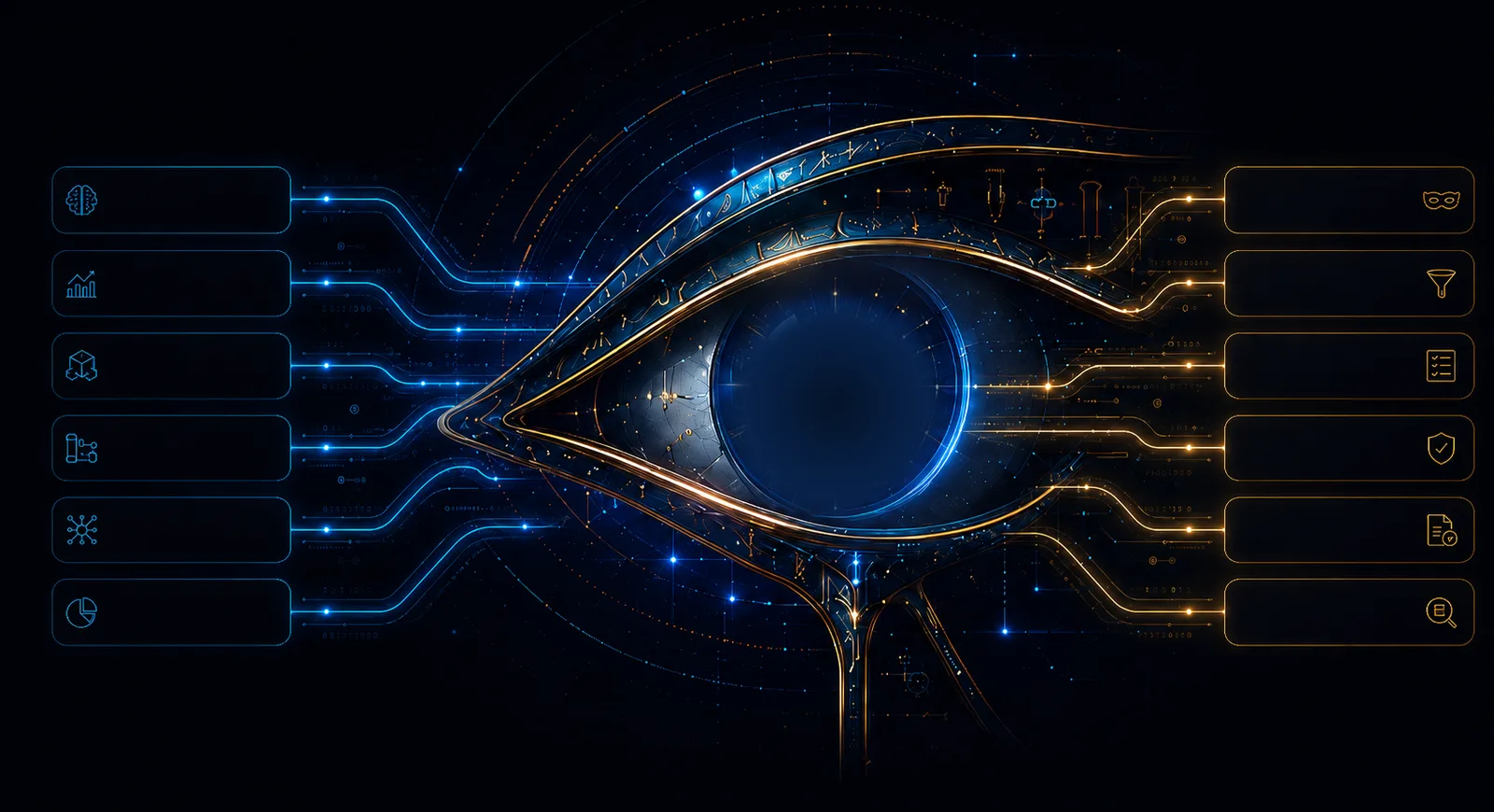

An AI coding tool is like a brilliant new consultant you turn loose in your filing room. It works incredibly fast — but it reads everything, including what no outsider should ever see: customer names, passwords, card numbers. Conarium is the checkpoint at the door: before the consultant sees a single file, it blacks out every secret, notes down everything that was looked at, and makes sure not one original ever leaves the building.
You decide what's allowed. You keep the key.
And the clever part — the company that makes Conarium never sees your files either. It runs inside your own walls, so there's nothing for anyone to leak.
Pick a sample or paste your own. See exactly what an AI assistant reads the moment you point it at real data — then flip Conarium on. Everything runs in your browser; nothing is ever uploaded.
This is a pattern-based preview. See what production masking does — and doesn't — catch →
Point Cursor or Copilot at a production database and it drinks the raw stream — national IDs, IBANs, balances, live keys. One prompt can expose your most sensitive tables. Security teams simply can't allow that.
| 1 | Ayşe Demir | TR00 0000 0000 0000 0000 0001 | 12345678901 | +90 5xx xxx 00 01 | ₺482,900 |
| 2 | Mehmet Yılmaz | TR00 0000 0000 0000 0000 0002 | 12345678902 | +90 5xx xxx 00 02 | ₺1,204,350 |
| 3 | Zeynep Kaya | TR00 0000 0000 0000 0000 0003 | 12345678903 | +90 5xx xxx 00 03 | ₺76,120 |
No narration — the real pipeline. A request arrives, the eye decides, and the audit writes itself.
Three queries a hostile assistant would actually send. Press one and watch what the gateway returns — and what lands in the audit log. Want to type your own? The box in the live demo above is open.
This is a live Conarium server with a governed sample database. Connect it to your own Claude in about 30 seconds and try to get the protected data out — the masked columns, the denied tables. You won't. What the policy allows, you will see, twenty-five rows per query: that is what allowing a table means.
https://demo.conarium.dev/t/conarium-public-demo-tryit-2026/mcp
In Claude, open Settings → Connectors → Add custom connector.
Paste the URL above, name it anything, and connect.
Ask it for the revenue. Then ask it for the customer list.
Business figures come back instantly. Governance isn't a wall; the work still gets done.
Sales rows arrive complete, but every name, phone and email is redacted before the model reads it.
Not permitted by policy. The AI can ask; it simply never gets an answer.
Sample data is entirely synthetic — no real company, no real people. The connector is read-only and rate-limited. This is the same code you can read on GitHub and run on your own server.
Emails, IDs, cards and secrets redacted in the response stream — before the model sees a character.
Whitelist what AI can access. Your secrets table stays invisible; unauthorized access throws PolicyError.
Hard per-query limits. No silent exfiltration of millions of rows. You stay in control.
Every access logged — who, what, when, rows, decision — in a hash-chained, tamper-evident ledger. Alter one entry and the chain shatters. Built for KVKK / GDPR evidence, no raw PII.
Every governed access can emit a portable receipt — Ed25519-signed, carrying the fields EU AI Act Article 12 / 19 asks for, with chain heads anchored to OpenTimestamps. An auditor checks it offline using conarium-verify: no Conarium install, no call back to us. It proves records were not altered, deleted, reordered or backdated after they were created — it does not claim they were correct when written.
DELETE, DROP, UPDATE, INSERT — blocked at the door. Even smuggled inside comments or stacked queries. The assistant can read; it can never wreck.
PII slipped past as base64 or hidden behind an alias (email AS contact)? Still caught. Masking follows the data, not just the column name.
Postgres, internal docs, OpenAPI specs, Jira and Slack — a single governed layer over all your scattered knowledge, spoken in MCP to every assistant.
Runs entirely on your infrastructure. Raw values stay in your perimeter — only policy-approved disclosure leaves. Not ours. Yours.
The one outbound call — a startup version check — is documented and switches off with one variable.
Claude, Codex, Cursor, Copilot. Bring whatever assistant your team already loves.
IBAN (mod-97), TCKN, cards (Luhn), TR phones (mobile, landline, 08xx, +90, spaced), email, passport MRZ only (TD3, 7-3-1 check digits), and IP (IPv4/IPv6) when you turn it on. Zero-width characters, fullwidth digits and @, unicode dashes, and email-shaped @ / \u0040 / %40 are normalised first. Wrapped base64 or hex tokens are unwrapped only when they decode to a detector hit.
policy.detectors can turn IP on or off. TCKN, cards, IBAN and email cannot be disabled — the schema rejects the key. A field longer than policy.scanCharCap (default 16 384) is replaced whole with [MASKED_PII]. It is never skipped. Skipping would be the way past the mask.
conarium-suggest-policy prints a maskColumns guess from column names. It does not write your config.
A hash chain cannot see a tail that is no longer in the file. conarium-verify --expect-count and --expect-last-hash pin length from outside.
Most products say they catch everything. The distinguishing fact is what this one refuses to pretend to catch — because a half-working detector is worse than none.
A street-address detector cannot tell Atatürk Caddesi from Atatürk Barajı without a gazetteer. A name detector cannot tell Deniz, Güneş or Umut from the words. Both need a dictionary or a model. This gateway's decisions are deterministic, so those stay out of the scanner. Close them with maskColumns and conarium-suggest-policy — a name-based guess that does not write your config.
Passport numbers outside MRZ. Double-encoded escapes such as @. An identity split across two unrelated fields.
The receipt chain is structurally blind to a tail that was deleted. Pin it with --expect-count, --expect-last-hash, or an external anchor.
Most tools are merely configured to be safe. Conarium is attacked by an adversarial red-team that tries to break every policy — write-smuggling, unauthorized access, PII slipped past the mask. Whatever it bypasses, we harden — then it attacks again to verify the fix. We don't claim secure. We prove it, and re-prove it.
A production AI assistant runs the author's own company ERP — its customers, suppliers and staff. Every one of the 121,366 real identities is pseudonymized before it ever reaches the model. The AI reasons on opaque tokens; the operator sees the real names on the way back. Raw contact data — phone, email, tax IDs — never crosses the boundary at all. The figure cannot be verified from outside.
Read Governance Report 001 - what it proves, what it does not, and the measurement error we made →
Three downloads and one verifier, on your machine, against the demo that is running right now. No account, no token, nothing of ours to install. The verifier is a single file that imports nothing from Conarium — so it cannot be the part that lies.
What this proves: the receipts were not altered, deleted, reordered or backdated after they were written, and the chain head was submitted to a public timestamp log. What it does not prove: that the records were correct at the moment they were created. The proof page says the same thing, in the same words.
Conarium is designed from the ground up for zero-trust environments. It runs inside your VPC, acts as a local MCP server, and ensures your raw data never leaves your perimeter.
No. Conarium is a stateless gateway. It processes data in memory to apply masking and row caps, then streams it directly to the local MCP client. The only thing written to disk is your PII-safe audit log.
Conarium intercepts PII and secrets before they reach the LLM; and because it runs self-hosted, you choose which model to use — including zero-retention endpoints — so the end-to-end data flow stays under your control.
Conarium provides an tamper-evident, append-only JSONL audit log of every database query made by AI, including the rows returned and the policies applied. This supports access-monitoring and data-governance controls.
As a standalone Node.js binary or Docker container within your VPC. It communicates with developer machines entirely over standard I/O (stdio) via the Model Context Protocol, meaning absolutely no open inbound ports.
Conarium sits between an AI assistant or agent and company data. Personal data is masked before the model sees it. Forbidden tables are denied at the policy level. Row caps stop bulk extraction. Every governed access is written to a hash-chained, PII-safe audit log. The gate contains no language model; masking and policy are deterministic rules.
Yes. The independent verifier is the conarium-verify binary. It runs offline, needs no Conarium installation, and makes no network call to the vendor. A receipt is checkable by someone who distrusts the vendor entirely. The published command is npx conarium-verify; passing --help prints usage without a receipt file.
Exit code 13 means the signature on a receipt or countersignature is invalid, or the keyId is unknown. Changing a field so the recomputed hash no longer matches the stored hash is exit 10. Changing the signature instead is exit 13. The verifier also uses exit 13 when a trusted public key is given without its sidecar keyid file.
No. Conarium is self-hosted. The vendor never receives customer data. The process applies masking and row caps in memory, then streams the result to the local MCP client. What is written to disk is the PII-safe audit log. The product runs inside the customer's own perimeter.
An MCP gateway with logging records that a call happened. A Conarium receipt attests to what the model was prevented from seeing, because the component that masks the data is the same component that signs the record. Coverage reconciliation then compares the database's own query counters against those receipts, so access the database recorded but no receipt covers is surfaced.
A Conarium Receipt proves that records have not been altered, deleted, reordered, or backdated after they were created. It does not prove they were correct at the moment of creation. The product runs on the customer's own infrastructure, so an operator can still decide what goes into a record.
Deploy Conarium locally or in your VPC, configure your policy, and attach it to your IDE.
A few big, well-funded companies touch this. Here is the honest difference.
They protect your data by first sending it to their servers. Conarium never sees it — it runs inside your walls.
They guard the door — who is allowed in. Conarium masks what is actually in the room.
They stop hackers from tricking your AI. Conarium stops your own trusted AI from quietly walking out with your data.
We couldn't leak your data if we wanted to — we don't have it.
Of the ten projects we scanned, none combines all three: enforcement before the model, a receipt you can verify without us, and reconciliation against the data source's own counters. That is the whole claim — we make no wider one.
Named comparison (one list): hoop.dev, Lasso, Bifrost, Docker MCP Gateway, MintMCP, Lunar MCPX — full table with numbers on compare.html. This grid shows two. Stars and last-commit dates re-measured 14 August 2026 from the GitHub API. Capability columns are from each project's own docs, last read 29–31 July 2026. “Not documented” means we could not find it documented — it does not mean the product lacks it. If we got something wrong about your project, email us and we will correct it.
See the named comparison, with numbers - including five places where they beat us →
Everything technical is free and yours. What you can buy is the one thing you cannot self-host: someone other than you signing the evidence.
The core is MIT-licensed and free forever — including the reconciliation and verification tools we run ourselves. Paid tiers answer the question an auditor asks after the technical one: who else vouches for this?
◇ Defined in the contract, not shipped yet. Everything unmarked is in the package today — download it and run it. The countersignature you receive stays with you: it lives in your receipt and in a public timestamp log, not in our systems.
The mechanisms behind these receipts are specified in an IETF Internet-Draft — draft-dogru-scitt-disclosure-evidence — and reviewed in public on the IETF SCITT mailing list. An outside engineer has re-run the verification suite against the published vectors, on the record.
Take this 30-second self-assessment to discover if your AI coding assistants are leaking sensitive PII to external models.

I built Conarium because I needed it myself. Our own ERP had to let AI work across 100,000+ real customer records and 10,000+ incoming messages a month — with zero chance of a leak. The governance layer that made that safe became this product.
If you're shipping AI on sensitive data and losing sleep over it, I'd like to hear from you. I answer every email personally.
This form is the waitlist — Business (not shipped yet), the Compliance Pilot, Enterprise, and the Design Partner program. Pro is priced, but its checkout is not open yet, so the Pro buttons bring you here too.Pro is sold separately: it goes to checkout, not here.
Conarium, aşağıdaki şirket tarafından işletilmektedir. Sorular: e.dogru@conarium.dev · +90 530 396 88 99
İletişim · Mesafeli Satış Sözleşmesi · İptal ve İade · Gizlilik
